
Evaporative coolers, often called swamp coolers, work by adding water to the air. That is exactly why they make sense on the dry South Plains, and it is also why homeowners ask whether they can cause mold. This guide sticks to what government sources actually say about evaporative coolers and about mold, and it explains what to do if you find mold on swamp cooler pads, around the unit, or in the rooms it serves.
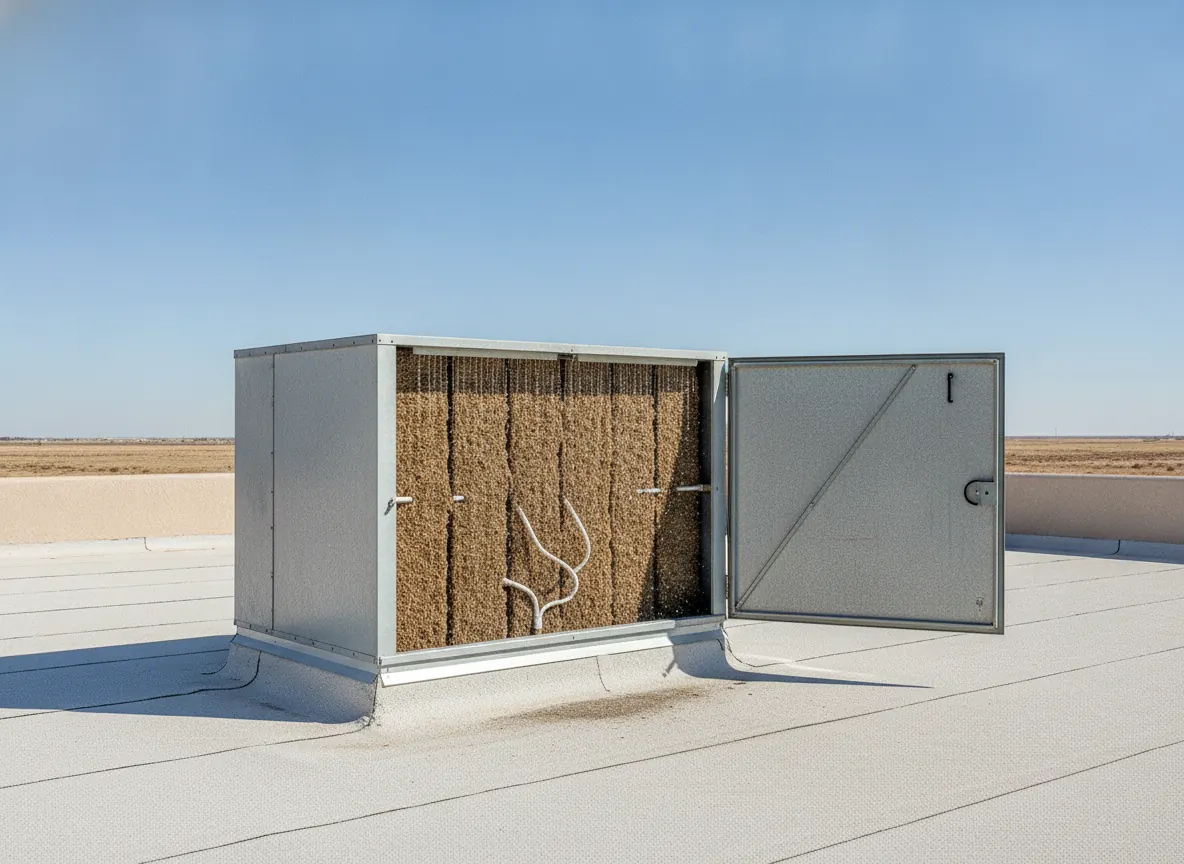
How a swamp cooler affects moisture in your home
The U.S. Department of Energy's Energy Saver guidance says evaporative coolers suit low-humidity areas and "should not be used in humid climates because they add humidity to the air in your home." DOE also says two-stage units add less humidity than single-stage units, and that coolers need regular maintenance, about monthly during the cooling season.
Lubbock's climate is the reason these units work here. NOAA's 1991–2020 normals put annual precipitation at Lubbock Preston Smith International Airport at 18.33 inches, and relative humidity at the airport averages roughly 50%, with much drier afternoons than mornings. The rain that does fall comes mostly in warm-season thunderstorms.
Do swamp coolers cause mold in the house?
The honest answer is that no authoritative source we found says swamp coolers, by themselves, cause mold in houses. What the sources do say is about moisture:
- EPA's mold guide: "The key to mold control is moisture control." Mold will not grow "without water or moisture."
- EPA recommends keeping indoor humidity below 60%, ideally between 30% and 50%.
- EPA: "It is important to dry water-damaged areas and items within 24-48 hours to prevent mold growth."
Put those together with DOE's point that coolers add humidity, and the practical risks become clear. A cooler that adds more moisture than a room can shed, or a unit that leaks water where it should not, creates the kind of conditions EPA tells homeowners to avoid. A well-maintained cooler in a dry climate is a different situation from a neglected one with a cracked pan.
Where the water goes wrong: leaks and worn parts
Texas's weatherization program (TDHCA) published guidance on evaporative coolers in 2020. It says: "ECs can be an extremely efficient cooling option for dry climate zones; however their components have a tendency to deteriorate over time." It lists "rusting, water calcification/mineral deposits, pump/motor failures" as problems, and it tells installers to "Inspect pan for signs of water leakage."
For a homeowner, that points to the places to look:
- The pan. Rust or mineral buildup can lead to leaks. Water dripping from a roof-mounted unit can reach the roof deck, attic or ceiling below.
- Standing water and wet pads. These need regular cleaning as part of the maintenance DOE describes.
- Ceilings and walls near the unit or its duct. Stains, bubbling paint or a musty odor near the cooler are reasons to find the water source.
- Indoor humidity. A hygrometer lets you compare your indoor reading with EPA's 30–50% target while the cooler runs.
Mold on swamp cooler pads
Pads stay wet by design, so growth or discoloration on them is a maintenance issue first. Follow the manufacturer's instructions for cleaning or replacing pads and cleaning the reservoir, and use only cleaners the manufacturer allows. Do not guess with chemicals; if the instructions do not cover it, ask the manufacturer or an HVAC technician.
The legal line matters here too. Texas Occupations Code §1958.002(b) says mold assessment and remediation do not include "routine cleaning" or "the diagnosis, repair, cleaning, or replacement of plumbing, heating, ventilation, air conditioning, electrical, or air duct systems or appliances" when those activities are "not conducted for the purpose of mold assessment or mold remediation." Ordinary cooler maintenance by you or a service technician generally falls in that category. Mold cleanup in your walls, ceiling or ducts is a different job.
This is general information, not legal advice. Texas mold rules are set by statute and TDLR rule, and SB 1255 (2025) changed parts of the law while TDLR updates its rules. For a question about your own situation, check with TDLR or a Texas attorney.
How to prevent mold in swamp coolers (and around them)
Maintain on schedule
DOE calls for regular maintenance, about monthly during the cooling season. Clean or replace pads and clean the reservoir per the manufacturer.
Check the pan and fittings
Follow TDHCA's advice to inspect the pan for leakage, and watch for rust and mineral buildup.
Watch indoor humidity
Keep it under EPA's 60% ceiling, ideally 30–50%.
Dry leaks fast
If the unit leaks into the house, dry wet materials within 24–48 hours, as EPA advises, and fix the cause. EPA: "If you clean up the mold, but don't fix the water problem, then, most likely, the mold problem will come back."
Close it up for winter
Follow the manufacturer's off-season steps for draining and covering the unit.
If mold has spread beyond the cooler
If you find mold on drywall, ceiling materials or in ductwork near the unit, the size and location matter. EPA's guide says that "If the moldy area is less than about 10 square feet... in most cases, you can handle the job yourself." That is advice, not a Texas rule.
The Texas licensing threshold is separate. Texas Occupations Code §1958.102(c) says a license is not required "to perform mold remediation in an area in which the mold contamination affects a total surface area for the project of less than 25 contiguous square feet." Homeowners working on their own home are exempt at any size under §1958.102(e) and 16 TAC §78.30(b), but a hired company needs a license once the job reaches 25 contiguous square feet. TDLR also has specific rules for mold remediation in HVAC systems, 16 TAC §78.130. Our post on the 25 square foot rule covers the details.
On a licensed job, a licensed assessor writes the protocol, a separate licensed remediator does the work, a licensed assessor performs clearance, and the owner gets a Certificate of Mold Damage Remediation (TDI form MDR-1) within 10 days.
What it may cost
Typical national ranges from cost guides, 2024–2026 (not quotes): HVAC system mold remediation $3,000–$10,000; ceilings $1,000–$9,000; attic $1,000–$9,000; mold inspection $450–$800. The real price comes from licensed pros after an on-site assessment. See the full cost guide.
Health questions
If you or someone in your home has symptoms you think may be related to mold, talk to a doctor. On testing, TDLR's consumer sheet notes that "the Centers for Disease Control (CDC) does not recommend routine sampling for molds," and EPA says that "In most cases, if visible mold growth is present, sampling is unnecessary."
Get help with cooler-related mold
We connect Lubbock-area homeowners with TDLR-licensed mold assessors and remediators for free, no-obligation quotes. Tell us what you're seeing and we'll help you get quotes from licensed local pros. Ask any company for its TDLR license number and check it on TDLR's license search. Start with our free quote form, or read our page on swamp cooler and HVAC mold. If a roof-mounted unit leaked into the attic, our roof leak mold page may help too. Call (727) 300-6656
Frequently asked questions
Do swamp coolers cause mold in the house?
No authoritative source we found says they do by themselves. The U.S. Department of Energy says evaporative coolers add humidity to indoor air, and EPA says mold control is moisture control, with indoor humidity ideally 30–50%. A leaking pan, standing water or overly humid rooms create conditions where mold can grow.
How do I prevent mold in my swamp cooler?
Follow the manufacturer's maintenance schedule; DOE suggests about monthly during the cooling season. Clean or replace pads, clean the reservoir, and inspect the pan for leaks, rust and mineral buildup, as Texas weatherization guidance advises. Keep indoor humidity below 60% and dry any leaks within 24–48 hours.
Is cleaning swamp cooler pads regulated as mold remediation in Texas?
Texas Occupations Code §1958.002(b) excludes routine cleaning and the cleaning or repair of HVAC systems and appliances from mold assessment and remediation when not done for that purpose. Mold on walls, ceilings or ducts is a separate matter governed by the 25 contiguous square foot rule. This is general information, not legal advice.